Hornbill vs Sunrise ITSM

A practical comparison for Sunrise 7 and Sunrise on-premise customers.
solutions_esm_social

Your platform doesn’t have to fail to start holding you back.

The question isn’t whether your current platform still works. It’s how much time, effort and budget it takes to stay current – and whether it can support the automation, AI governance and joined-up service experience you need next.

Sunrise is changing. Is your roadmap clear?

Since its acquisition by Volaris in 2022, Sunrise has changed ownership, changed leadership and become part of a much larger portfolio of software companies.​

They’re also recruiting new developers to build a new service management platform from the ground up. But if your organization currently depends on Sunrise 7, it raises some important questions:​

  • Which future capabilities will be available on the platform you use today?

  • How much ongoing development investment will Sunrise 7 receive?

  • When will customers be able to use the new capabilities?

  • Will moving to the new product be an upgrade or a fresh implementation?

  • What will happen to your data, workflows, integrations, reports and customisations?

Quantified customer outcomes

2x IT case throughput

2x IT case throughput

Mid and South Essex NHS Foundation Trust doubled IT case processing without increasing team headcount.

Read the case study

60% reduction in HR case cost

60% case reduction of HR case cost

Guy’s and St Thomas’ digitised 150,000 HR requests across 50 request types, cutting the average cost per case by 60%.

Read the case study

90% portal adoption

90% portal adoption

Square Enix shifted employee behaviour from 80% email to 90% portal interaction, creating capacity for further service improvement.

See all customer stories

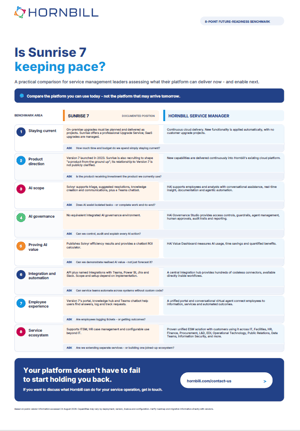
Compare Sunrise ITSM vs Hornbill Service Manager


Sunrise

Hornbill

Ownership and control

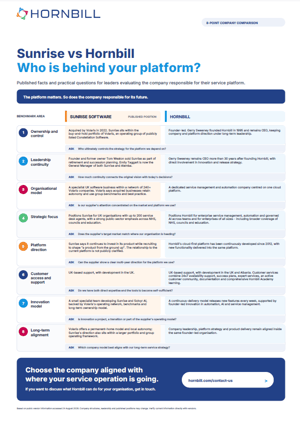
Owned by Volaris. Customers should seek clarity on how the short-term profitability goal of private equity is balanced with long-term product investment and customer satisfaction.

Gerry Sweeney founded Hornbill in 1995 and remains CEO, keeping company and platform direction under long-term leadership. We’re not beholden to a private equity group.

Upgrades

On-premise upgrades must be arranged and managed as customer projects. Staying current may require professional services.

Continuous cloud delivery applies new capabilities and security updates automatically, without customer-led upgrade projects.

Automation

Solvyr supports activities such as triage, suggested resolutions, knowledge creation and communication.

Hornbill HAi combines conversational support, analyst assistance and agentic automation that coordinates and executes outcomes—not just tasks.

AI governance and ROI

No equivalent integrated AI governance environment.

HAi Governance Studio provides controls, guardrails, approvals, auditability and reporting, while the HAi Value Dashboard measures usage, time saved and quantified cost reduction.

Integration

APIs and named integrations are available, with scope dependent on implementation.

Hornbill's central integration hub provides hundreds of codeless integrations that service teams can use directly inside drag-and-drop workflows. 

ESM unification 

Supports ITSM, HR case management and configurable use beyond IT.

A proven, unified ESM platform used across IT, Facilities, HR, Finance, Procurement, L&D, EDI, Operational Technology, Public Relations, Data Teams, Information Security and more. 

Opening Quote Mark Used to dipict the start of a customer quote

Why we love Hornbill...

The service designer lets any team take control over processes and automation to deliver services more quickly and efficiently”

Comparing capabilities

See how Hornbill and Sunrise compare across 8 key functional areas
Comparing companies

The platform matters. So does the company responsible for its future.
Questions Sunrise customers ask before switching

Yes. Hornbill Service Manager provides the core capabilities expected of enterprise ITSM, including incident, request, problem, change, service catalogue, asset, configuration and knowledge management. However, it should not be viewed simply as a like-for-like copy of Sunrise. Hornbill is a continuously delivered cloud platform that brings ITSM, enterprise service management, codeless workflow, integration and governed AI together. This means you can replace the processes you rely on today while creating room to automate more work, improve self-service and extend service management beyond IT. The comparison is therefore not only feature against feature, but what each platform enables you to achieve next.

Yes. Hornbill can replace an on-premise Sunrise environment, but the move is treated as a planned platform transition rather than a technical version upgrade. Discovery establishes which services, workflows, integrations, reports and historical data are genuinely required in the new environment. Hornbill can then be configured around priority outcomes, with data migration, testing, training and cutover planned around operational risk. Depending on complexity, an organisation may move in one controlled go-live or adopt Hornbill progressively by service or team. This also provides an opportunity to simplify legacy processes instead of carrying years of unnecessary configuration into a modern cloud platform. 

Hornbill uses continuous cloud delivery, with new functionality and platform updates applied automatically. Customers do not have to install major releases, maintain application infrastructure or commission recurring upgrade projects simply to remain current. This removes much of the planning, testing and professional-services effort traditionally associated with on-premise version changes. It also keeps customers on a common, supported service, so Hornbill’s support and development resources are not divided across multiple legacy versions. Organisations retain control over how and when they introduce new capabilities into their operating model, while the underlying platform is kept current by Hornbill.

Yes, but migration should be selective and purposeful. The first step is to determine which data has operational, reporting or compliance value—for example, users, services, assets, knowledge and relevant request history. Source data is then assessed for quality, ownership and mapping before it is imported, validated and reconciled in Hornbill. The same principle applies to service processes. Existing workflows can inform the new design, but they do not have to be reproduced exactly if a simpler or more automated approach would deliver a better result. The final scope, migration method and timescale will depend on the Sunrise deployment and the volume and condition of the data. 

Sunrise positions Solvyr primarily around AI-assisted service desk activities, including automatic triage, suggested resolutions, knowledge creation, sentiment analysis and improved communications. Hornbill HAi covers analyst assistance too, but extends AI across the wider service experience: conversational employee support, agentic automation that can coordinate and execute approved work, and integrated controls for governing that activity. In simple terms, Solvyr is largely presented as helping analysts handle tickets more efficiently; Hornbill’s broader proposition is to reduce the need for routine tickets and safely automate more of the work behind them.

Hornbill embeds AI oversight into HAi Governance Studio. Role-based access controls define who can use individual AI capabilities, while guardrails and data boundaries limit which systems, services and information AI can access. Agent-level controls determine what each agent can do, and human-in-the-loop approvals can be required before sensitive or high-impact actions proceed. AI activity is recorded through audit trails and reporting, making actions transparent and reviewable. The HAi Value Dashboard also tracks adoption, usage, time savings and cost reduction, helping organisations demonstrate whether AI is producing measurable value rather than simply adding another layer of technology. 

Yes. Hornbill is designed as a unified enterprise service management platform, allowing IT, HR, Facilities, Finance, Procurement, L&D, EDI, Operational Technology, Public Relations, Data Teams, Information Security and other functions to manage services in one environment. Each team can retain its own catalogue, workflows, queues, permissions and service measures while sharing a common portal, data model and automation layer. This makes cross-department processes easier to coordinate and gives employees a more joined-up way to request help. Organisations can begin with ITSM and expand progressively, avoiding the need to buy and integrate a separate service management tool for every business function.

Let's talk about what comes next

If you’re considering your options beyond Sunrise, I can help you work through them. Bring me one service, workflow or migration concern and we’ll explore how Hornbill could approach it, what could be simplified and where the greatest value might lie. You’ll leave with a clearer view of the practical options—without having to sit through a generic sales presentation. 


IMAGE NEEDS SWITCHED-OUT FOR MANISH PHOTO/BIO

Capterra 4.7 Stars
Software Advice 4.7
Get App User Reviews - 4.7

See Hornbill in action

Demo Contact