CUSTOMER SUCCESS STORY:

70% self-service adoption. Twice the IT case throughput.

C03_Warwickshire_MAIN_logo_video_thumb
  • 20,000

    employees

  • 1.3m

    citizens

  • 85,000

    calls per year

  • 165,000

    requests per year

Joined-up IT services. More time for patient care.

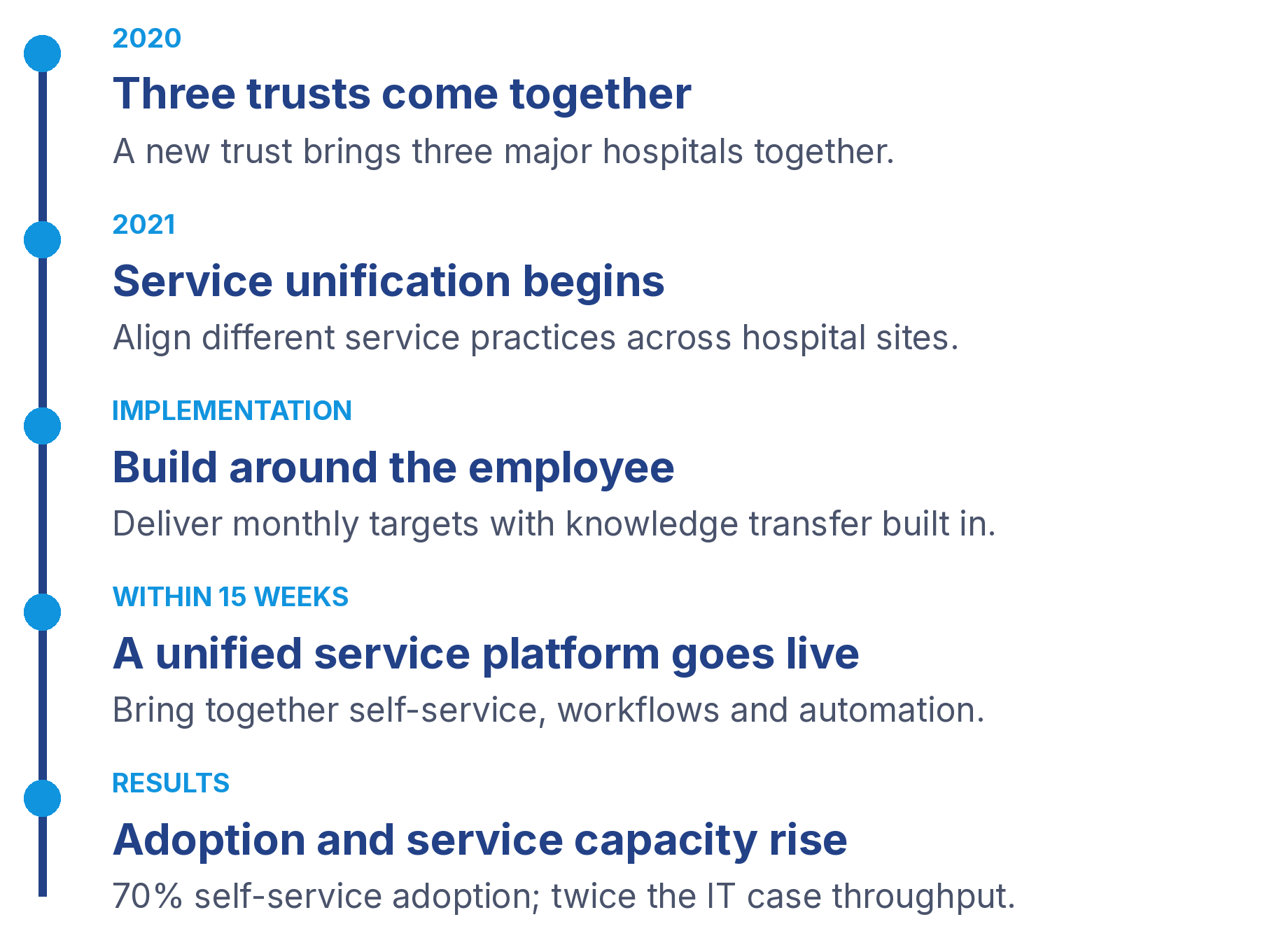
Following the merger of three trusts, Mid and South Essex needed to bring different service practices, processes and systems together. Hornbill provides a shared platform for self-service, service management and automation, creating a consistent experience for employees across hospital sites.

RESULTS

Faster responses. Greater capacity.

The trust moved from fragmented service delivery to a unified approach, making self-service easier to use and automating routine IT work. 

  • 90% reduction in average response time. From five days to half a day. 

  • 70% self-service adoption. Up from adoption levels of 5–15% across the three hospitals.

  • 2x IT case throughput. Achieved without increasing headcount.

  • Unified incident, request, and change management.

  • Requests assigned to the right teams, first time.
  • One place to manage 40,000+ devices, improving asset visibility and control.
  • Less routine work for IT, freeing capacity for higher-value activity.

CUSTOMER INSIGHT

Design support around the people who need it

The trust shifted from an operations-focused approach to one shaped around its employees. Working with Hornbill, it introduced an intuitive portal that makes it easy for people to request services and feel confident about the outcome.

Behind the portal, the trust unified incident, request and change management. Orchestrated workflows direct requests to the right teams, while integrations coordinate actions across cloud and on-premises systems. This connected the employee-facing experience with the work needed to deliver outcomes, boosting speed and consistency.

The trust also used analytics to identify opportunities to streamline service interactions. Automation reduced routine administration, including generating change advisory board agendas, while centralised asset management brought visibility of more than 40,000 devices into one place.

Together, these changes helped self-service adoption reach 70% and enabled IT teams to handle twice as many cases without increasing headcount. Employees receive faster, more consistent support, giving clinicians more time to focus on patient care.

What the trust needed

From separate service desks to a consistent employee experience

Challenges

The merger brought together three major hospitals with different service practices and processes. Low self-service adoption and high demand placed pressure on service desk teams, while a complex technology estate made coordination and visibility difficult.

  • Service desks received 85,000+ calls and 165,000+ requests annually before unification.
  • Self-service adoption varied between 5% and 15%.
  • Different sites followed different practices and processes.
  • IT supported 400+ systems and 40,000+ user devices.
  • Average response time was five days.

Requirements

The trust needed a shared service management platform that would create a consistent experience across its hospitals. It also wanted to improve responsiveness, automate routine work and use data to make services more effective.

  • Provide one employee self-service experience across sites.
  • Route work to the right team first time.
  • Reduce response times and improve consistency.
  • Automate IT processes across cloud and on-premises systems.
  • Bring together analytics, asset information and service activity.

“The portal needed to work for our customers – both in the way they interact to raise requests but also having confidence that we’re an outcome driven service provider.”

Steve Whittle, Head of Digital Operations, Mid and South Essex NHS Foundation Trust

THE JOURNEY

A unified service platform in 15 weeks

Hornbill and the trust worked through an agile implementation programme with monthly delivery targets. Knowledge transfer formed part of each stage, helping the team become self-sufficient while introducing the service desk, employee portal, workflows, automation and supporting capabilities within the planned timescale. 
Why the trust chose Hornbill

 Hornbill brought together the capabilities the trust needed to unify service delivery, improve employee interactions and reduce routine IT effort.

1. A shared employee experience

One self-service portal and service catalogue gives employees a consistent way to access support across the trust’s major and community hospitals.

2. Automation across the IT estate

Connected workflows and integrations coordinate actions across cloud and on-premises systems, improving the speed and consistency of service delivery.

3. Delivery with knowledge transfer built in

An agile implementation approach combined monthly targets with ongoing knowledge transfer, helping the trust deliver on time, and manage the platform independently.

“We've probably streamlined around 100 processes… one of the best is our joiners process. Customers don’t have to raise multiple calls anymore.”

Adrian Simpkins, Enterprise Systems Manager, Mid and South Essex NHS Foundation Trust

Other public sector organisations we've helped

  • Public Service Ombudsman
  • Lambeth Council logo
  • Greater Manchester Combined Authority Logo
  • City of York Council logo
  • Southend on Sea Council logo
  • Waltham Forest Council logo
  • Northumberland County Council logo
  • North_Ayrshire_logo

Get in touch