Why employees still avoid self-service

Self-service should make getting help easier—but many portals simply transfer effort from service teams to employees. Discover why employees still choose email, chat and telephone, and why the answer is a better service experience rather than another adoption campaign.
Self-service was supposed to make getting help faster and easier. Yet many employees still bypass the portal, email the service desk, send a message in Teams or just ask a colleague what to do.
Organisations often treat this as an adoption problem. They launch another communications campaign, reorganise the catalogue or ask employees to “use the portal” when they get in touch. But if people repeatedly choose another route, it's most likely that self-service is creating more work for them—not less. Employees aren't resisting self-service as a concept. They're resisting friction.
Employees don't want self-service. They want service.
The phrase self-service reflects the organisation’s perspective. It describes a delivery model: employees perform part of the work themselves so that service teams can handle demand more efficiently. But employees aren't trying to participate in a delivery model. They're trying to reset a password, gain access to an application, find a policy, request equipment or tell someone that something is broken. Their goal is the outcome—not the channel used to reach it. When the quickest route appears to be sending an email or contacting someone they know, that is what they'll do. From the employee’s point of view, this is entirely rational behaviour.
The real measure of self-service isn't how many people visit the portal. It's how easily they can get something done.
Most portals expose the organisation's complexity
Traditional self-service often begins by asking an employee to make decisions they aren't trained to make:
- Which department owns this issue?
- Which portal should they use?
- Which category best describes the request?
- Is it an incident, a service request or something else?
- Which form contains the right set of fields?
These choices make sense to the teams receiving the work because they reflect internal structures, processes and reporting requirements. To an employee, they're confusing barriers getting in the way of the outcome.
Someone who can't connect to a system shouldn't need to understand the boundaries between IT, HR, facilities and security before asking for help. Yet many self-service experiences require exactly that. Instead of shielding people from organisational complexity, the portal turns that complexity into a navigation system.
A form is not the same as a service
Many organisations have digitised the front end of service without changing what happens next. The employee completes a form, receives a reference number and waits for a person to process the request.
This can improve consistency and data capture for the service team, but it doesn't improve the employee’s experience. It simply transfers administrative effort from the service team to the employee.
The employee must find the right form, provide information the organisation may already hold and translate their need into the language of the process. If the request reaches the wrong team or lacks context, they may then have to explain everything again. The interaction is digital, but the underlying service remains manual. If self-service only creates a better-structured ticket, employees will see no advantage over sending an email.
The experience ends too early
Another common problem is that self-service is designed around submission rather than resolution. The portal helps the employee log a request—but their journey continues. They still need to know what's happening, whether anything is required from them and when they can expect an outcome. When updates are vague or difficult to find, they switch channel to chase progress. A single need becomes several interactions: a portal submission, a follow-up email, a Teams message and perhaps a telephone call. The employee experiences more effort, while the service team receives duplicate demand that must be reconciled manually.
This is why a high number of portal submissions doesn't automatically mean that self-service is working. Adoption can rise while employee effort, avoidable contact and dissatisfaction remain stubbornly high.
More content and choice makes matters worse
When adoption is low, the instinctive response is often to add more: more catalogue items, more knowledge articles, more guidance, and more links. But volume isn't the same as usefulness. A large knowledge base is of little value if employees can't find the right answer, trust that it's current, or apply it to their situation. A comprehensive catalogue can become harder to navigate with every service added. The burden remains on the employee to search, interpret and choose correctly.
What appears to the organisation as greater self-service capability can feel to the employee like a growing maze of complexity.
From a portal to visit to a front door that understands
The next generation of self-service starts from a different premise: employees shouldn't have to understand how the organisation works in order to get something done.
Instead of forcing people to navigate structures and translate their needs into predefined categories, an AI-powered front door allows them to describe what they need in natural language. It can interpret intent, gather relevant context, draw on trusted knowledge and connect the conversation to the appropriate workflow or service team (while operating under an AI governance framework).
The important shift isn't from portal to chatbot (one mechanism to another). It's from capturing demand to capturing and resolving it. The portal still has a role. It can provide visibility, structured journeys and access to more complex services. But it no longer needs to be the only way in—or require the employee to do all the navigating.
The new experience begins where the employee already works (for example Teams integration) and continues with its context intact—whether the outcome is an immediate answer, an automated action or a well-informed handover to a person.
Stop asking how to drive adoption
The best way to persuade more employees to use self-service is to provide them with a better experience. It must be the channel of least friction. The question to ask is “How do we make this the easiest and most effective way for employees to get something done?”
That changes the focus from channel compliance to employee outcomes. It also reveals why another portal redesign or communications campaign may deliver only temporary improvement.
Make it simple, connected and genuinely useful, and adoption becomes a consequence of good service—not a target that must be continually enforced.
What is the key to high self-service adoption?
Ultimately, success with self-service relies on understanding one key principle: employees will adopt an experience that works best for them. An AI powered self-service experience can help your employees with a broad range of service and support outcomes through natural language conversations with less friction than other channels.
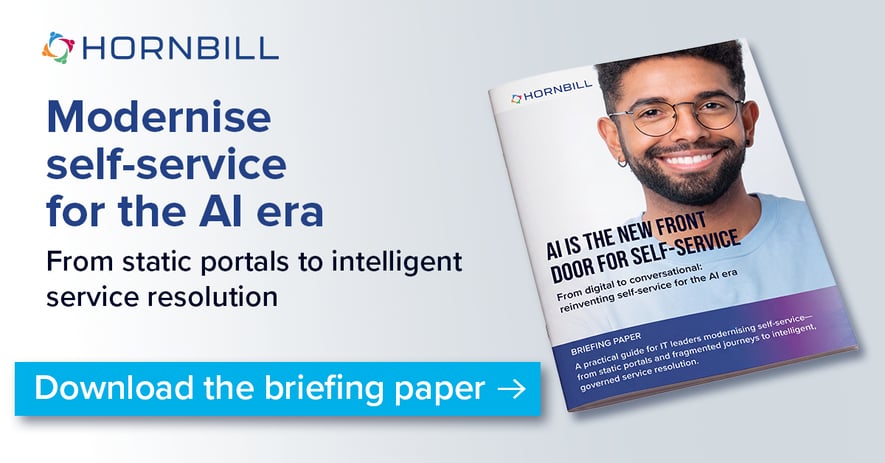
AI is the new front door for self-service is a detailed guide for IT leaders who want to modernise self-service.
Download the report to learn how to make the shift from static portals and fragmented journeys to intelligent, governed request resolution.
More about AI in service management
Related posts
Zero ticket - The next evolution of service management ->