What is agentic AI?

Everyone’s talking about agentic AI…but what does it really mean? And why should service desk agents and IT managers care? Let’s break it down in plain language.
Defining agentic AI
The simple definition: Agentic AI is AI that can take action to achieve a goal (not just generate content). Where generative AI produces answers in response to prompts, agentic AI acts. You give it an outcome, and it works out how to get there. Agentic AI doesn’t just think. It does. It delivers outcomes in real-world situations.
For example, a generative AI can write a password reset guide. But an agentic AI can interact conversationally with an end user, identify that they need a password reset—and reset the password for them automatically.
👇 Infographic: See the differences between GenAI and agentic AI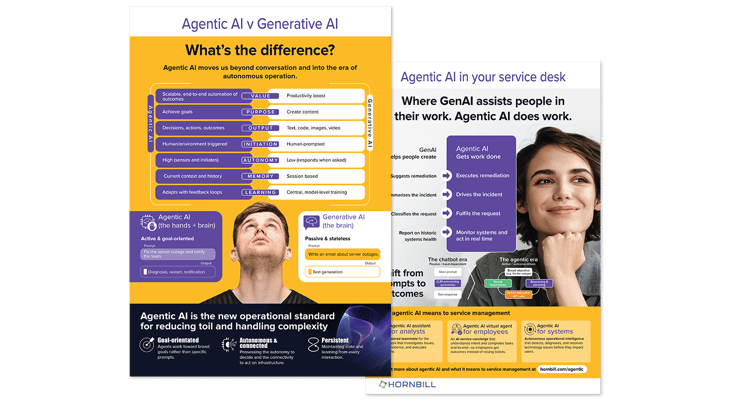
How agentic AI works
Agentic AI understands user intent and the surrounding context, decides the best course of action, and carries it out using integration with systems. Then it checks whether the outcome was successful and, if not, adapts its approach. This allows it to complete tasks reliably, improving results over time without constant human direction.
Understanding context and intent
Agentic AI can understand the intent of what you need, and the context in which you need it. For example, when a user wants to regain access to an existing system account, the AI will need to understand the context accordingly to deliver the right outcome. That means finding out:
- Who is the user? What is their identity, role, and permissions?
- Which system are they referring to?
- What is the precise nature of the issue? (Did they forget their password? Was the account locked? Was it an MFA failure?)
- What does their recent activity look like? Did they recently change their password?
- What are the security policies at play? Can the user account be auto-unlocked, or is human intervention from an authorise manager required?
To simplify and accelerate the employee experience, an agentic AI can gather much of the contextual information that is required automatically—instead of asking the end user a long series of questions. To do this, an agentic AI must be empowered to connect with the necessary systems. We’ll talk more about integrations in a moment.
Deciding what to do next
Now that it has a full understanding, it can decide how to achieve the objective. If you stop and think about this for a moment, you start to appreciate how profound this is. It’s not just about handing over step-by-step workflows from people to machines. Traditional workflow automation can already do that. It’s about handing-over more complex tasks where a number of decisions are required throughout the process. This raises the “waterline” of what’s automatable—shifting a wide range of repetitive and tedious tasks from people to machines (tasks that were, because of their complexity and variation, previously out of reach of traditional rules-based workflows).
An agentic AI plans how to deliver an outcome by first evaluating possible ways to solve the problem, then selecting the most appropriate path based on context. It considers factors such as business impact, user role, system criticality, and organisational policies or constraints. It weighs risk, efficiency, and likelihood of success before acting. If needed, it can break the task into steps, adjust its plan as new information emerges, and choose safer or approved routes when risk or uncertainty is higher.
Taking action across connected system
Connecting systems to gather the contextual information needed to get this far is one part of agentic AI’s need for integration. The other is connecting with systems so it can action the plan and deliver the outcome.
This is where agentic AI moves from planning to execution. It needs the ability to interact directly with ITSM/ESM tools, identity platforms, endpoint management, monitoring systems, and business applications. Through these integrations, it can carry out tasks such as resetting passwords, provisioning access, restarting services, or updating records—without manual intervention.
Crucially, these actions must be governed. Permissions, policies, and audit trails ensure the AI only does what it’s allowed to do, in the right way. With the right integrations in place, agentic AI doesn’t just recommend the next step—it completes it, end-to-end.
Checking results and adjusting if needed
Agentic AI doesn’t assume its first action worked—it verifies the outcome. After taking action, it looks for signals of success (e.g. login restored, system performance improved, access granted). If the issue persists, it reassesses the situation, tries an alternative approach, or escalates to a human agent. This creates a feedback loop where the AI continuously tests, learns, and refines its actions until the desired outcome is achieved reliably and safely.
What can agentic AI do for your service desk?
Understanding the goal. Deciding what to do. Taking action. Checking it worked. It’s no different from what human service desk agents do. But it’s automatic. That means it can handle a large share of routine, high-volume requests and issues—including interacting directly with end users. It can reset passwords, fulfil access requests, resolve common incidents, and even act proactively.
It’s like adding a highly-trained, 24/7 analyst to your team who can deal with many tickets at a time.
But it doesn’t have to be fully autonomous. AI governance is an important success factor. That’s why most organisations choose to keep humans in the loop—approving actions and stepping in where judgement or risk demands it (at least until it has been demonstrated that the agentic AI can reliably handle a specific use case).
Elevate human agents above the mundane
Agentic represents a fundamental shift for service desks—from responding to requests to delivering outcomes automatically. By combining understanding, decision-making, and action, it reduces the manual grind, accelerates resolution, and enables more proactive support. The result is a smarter, more efficient service desk where routine work is handled seamlessly—and human teams can focus on higher-value, more strategic (and more satisfying) activities.
Read more
-
What agentic AI means for the future of servicie management ->
-
Automation vs autonomy - How agentic AI is different from traditional automation ->
Find out more about Hornbill AI
- What agentic AI means for the future of service management ->
- AI for agent efficiency ->
- AI for end users ->
- AI governance ->
- AI data readiness ->
- Generative AI ->
- Measuring the value of AI in ITSM ->
- Hyperautomation in ITSM...and where AI fits in ->