Automation vs autonomy - How agentic AI is different from traditional automation

Automation was built to follow instructions. Agentic AI was built to interpret intent, reason, plan, and act. That single difference explains why AI is transforming service management faster than any previous wave of technology—and why organisations must rethink everything from workflows and operating models to governance and risk.
For years, organisations have invested heavily in automation to get more work done, faster and more consistently. Workflow automation. Robotic Process Automation (RPA). Integration platforms. Scripts and rules engines. These technologies were designed with one fundamental goal: shift work away from people and onto machines. They all reduce manual effort, accelerate outcomes, improve consistency, and free people to focus on more valuable work. Human work becomes machines work.
Agentic AI is part of the same story, but there are big differences between agentic AI and what came before. While traditional automation and AI may sit under the same automation strategy, they’re fundamentally different in how they work—and that difference matters. It’s a revolution, not an evolution, so AI can't simply be treated as more of the same thing.
Traditional automation is deterministic
Traditional automation mechanisms follow rigid, predefined rules. A workflow executes a series of steps that have been designed by a human. An RPA bot repeats a captured process exactly as it was recorded. A script performs the same actions every time it’s triggered.
The common theme is that traditional automation is deterministic. It is determined, precisely, by a human being. It is fixed. The exact path from trigger to completion is mapped out. Given the same inputs, it will produce the same outputs every time. That predictability is one of its greatest strengths.
If a workflow has been carefully designed, tested, and governed, organisations can rely on it to execute consistently and safely at scale. This makes traditional automation ideal for highly structured, repeatable, business-critical processes where consistency matters more than flexibility.
Examples of processes which are suited to workflow automations are:
- Payroll processing
- Financial approvals
- User provisioning
- Compliance workflows
- Procurement routing
- Password resets
In these situations, predictability is a big part of the goal: organisations want automations to follow strict rules—with minimal variation. Traditional automation works well in these situations because it operates within clearly defined boundaries. But it has limitations. It only works well when the process is known, the rules are stable, the environment is predictable, and the inputs are structured. The minute the environment shifts, an automation can break.
An automation only follows the path it was designed to follow. An RPA bot can only follow the process it was trained to replicate. If apps change, processes evolve, or any exceptions appear, human intervention is required—to complete the process and review/rebuild the workflow.
Hornbill workflow automation ->
AI introduces autonomy…and flexibility
Agentic AI changes the equation because it goes beyond following fixed instructions. AI models operate using statistical probability rather than deterministic rules. Instead of executing predefined paths, AI interprets patterns, predicts likely outcomes, and makes decisions based on probabilities. This makes AI fundamentally non-deterministic. It’s this flexibility that gives AI its power.
Unlike traditional automation, AI can operate in environments that are:
- Variable
- Ambiguous
- Conversational
- Dynamic
- Unstructured
AI can interpret intent, rather than simply following instructions. This is the shift from automation to autonomy. AI can understand natural language, reason across multiple sources of information, make contextual decisions, and determine the best course of action—across multiple steps. Where traditional automation executes logic predefined by people, agentic AI can generate logic dynamically without human guidance.
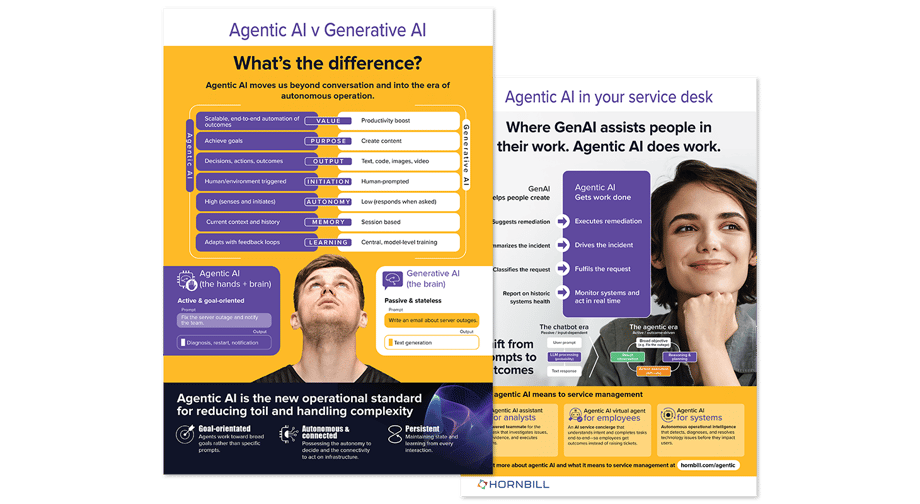
Find out more about what agentic AI can do (infographic) ->
Why this matters in service management
The distinction between automation and autonomy is very important to the future of service management and enterprise service operations. Traditional workflows are great for well-structured operational processes, but many service interactions are not predictable. They have a degree of variation that goes beyond the capabilities of fixed workflows.
Employees describe issues differently. Customers communicate ambiguously. Situations evolve in real time. These things tend to “break” rigid workflows. Context matters.
An AI-powered virtual assistant can understand what an employee is trying to achieve, conversationally. It can search knowledge, interpret intent beyond the immediate conversation, reason across multiple sources of context, and orchestrate actions across systems to deliver outcomes conversationally. Where a traditional workflow handles one outcome, an agentic AI assistant is versatile enough to handle many outcomes—much like a human agent is.
One of the common mistakes that organisations make is to assume that AI should replace every form of automation. It can, but it shouldn’t. Different types of work require different automation approaches.
Traditional automation is best for:
- Highly structured processes
- Compliance-sensitive workflows
- Stable operational procedures
- Repeatable transactional work
- Environments where predictability is required
Agentic AI is best for:
- High volume service interactions
- Variable workflows
- Conversational engagement
- Unstructured requests
- Contextual decision-making on the fly
- Dynamic environments where predictability isn’t a critical factor
Traditional automation and agentic AI excel at different things within an organisation. The future of IT and enterprise service operations can’t be built entirely on workflows, nor can it be built entirely on autonomous AI. It’s not AI instead of workflows. It’s AI plus workflows. Organisations require a layered strategy where workflows provide consistency, AI delivers adaptability, and governance provides control (with human-in-the-loop judgement in cases where risks are high).
Autonomous systems bring new governance challenges
The shift from deterministic workflows to non-deterministic AI systems changes the focus of governance. Where a workflow will do exactly what it is designed to do (with governance and compliance baked-into the workflow), AI introduces a new risk profile. The more autonomous a system becomes, the more important governance becomes.
Because agentic AI operates probabilistically and takes actions to deliver outcomes, organisations need to think about permissions, data access, escalation boundaries, human oversight, explainability, auditability, and operational guardrails.
This is important in every organisation because AI could be accessing employee data, HR records, financial systems, and customer information. AI governance must be designed into the implementation from day one, not an afterthought when it’s already operational.
What IT leaders should do next
The organisations gaining the most value from AI are not the ones moving fastest. They are the ones building the right operational foundations.
That means understanding where deterministic automation remains the best solution—and where autonomous AI can unlock entirely new levels of productivity, responsiveness, and service experience.
It also means recognising that AI adoption is not purely a technology project.
It is an operational transformation initiative. Success depends on data readiness, organisational knowledge stores, governance, security controls, workflow maturity, human oversight, and operational boundaries.
Without those foundations, AI simply accelerates existing operational weaknesses. Poor-quality knowledge and operational data creates poor AI outcomes. Weak governance creates risk. Broken workflows become broken workflows running at machine speed. And without clearly defined operational guardrails, organisations risk creating automation that employees do not trust and leaders cannot confidently control.
The winners will not be the organisations that race to replace everything with AI. They’ll be the organisations that orchestrate humans, workflows, and AI together.

More about agentic AI
What is agentic AI ->
What agentic AI means for the future of servicie management ->
Why agentic AI changes everything for service desks ->
AI in ITSM: data is the key to success ->
Find out about Hornbill AI
AI for agent efficiency ->
AI for end users ->
AI governance ->
AI data readiness ->
Generative AI ->